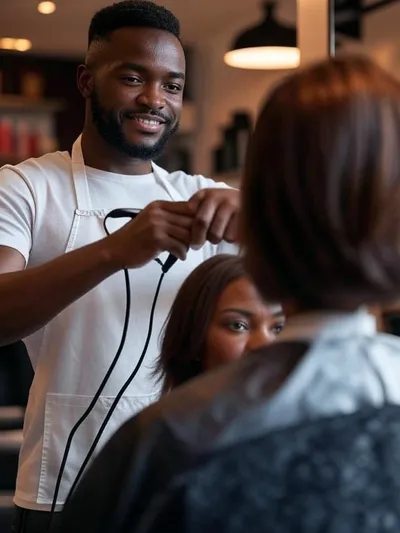
The Hairdressing and Beauty Services industry has long been considered a domain for women, and it still is, but the number of male hairdressers and beauticians entering the field has been growing.
In fact, according to Brian Mwaura of NeatNails Haven along Thika Road, “ the industry is very welcoming to male stylists.”
“Many clients prefer men in this job because men don’t compete with their clients and they have the energy needed for example when doing pedicure,” he added.
Men are also considered better at this job by most clients.
“Female clients prefer men because they are kind hearted and can also massage better when plaiting,” according to Caesare Karoki of Hollywood Salon and Spa in Juja.
“Men are more adventurous and open to new ideas,” adds Brian.
That women have dominated the field is expected considering that most of the industry’s clients have long been women and that the profession demands attention to detail, compassion, and strong interpersonal skills commonly associated with women.
But that is changing because the need for hairdressers and beauticians has been exceeding the supply and men are filling the gap.
According to Karoki, “the industry is becoming more inclusive for male stylists, that we are retiring women early from these jobs.”
For many individuals, hairdressers and beauticians are becoming increasingly irreplaceable in their lives as part of their presentation is looking good. Examples include people working in media and entertainment, fashion and beauty, hospitality, the corporate world, and client-facing roles.
“We are entering an era where the new norm isn’t just about looking good at work as an end in itself. Looking good is no longer only about being presentable but about power, perception, and inconsistent expectations,” says Ken Sayanga, a client of Brian.
And it is up to hairdressers and beauticians to help their clients meet these standards. This opens the field to unlimited customers and expectations that one gender or group of people alone cannot realistically fulfill.
“Professionals in the hairdressing industry must cut and trim, shampoo, condition, treat the scalp, blow-dry, straighten, curl, and color hair to suit client face shapes and preferences. We also recommend products for hair type and condition and need to understand hair and scalp health,” says Fredrick Chiaga, a male hairdresser and beautician.
“Beauticians do facials, including cleansing, exfoliating, and hydrating, among other forms of hair removal. We do makeup applications for everyday wear or special occasions, manicures, pedicures, nail art, eyebrow shaping, eyelash tinting and extensions, skin analysis, and skincare recommendations,” he adds.
Depending on their training, they sometimes perform massages or body treatments like scrubs, thus increasing their workload, which explains the growth of the male gender in this industry.
The growth of colleges training future practitioners is moving in tandem with the growth of men in these professions.
Hairdressing specialists need to have a deep understanding of hair textures, growth patterns, and chemical processes, knowledge of current hairstyle trends and techniques, a good eye for symmetry, shape, and aesthetics, and strong customer service skills.
Beauticians must possess knowledge of skin types, conditions, and product ingredients, color theory for makeup and skin tone matching, hygiene, sterilization practices, gentle and precise hand techniques, and discretion and professionalism, as clients often share personal details.
Male beauticians face challenges in their work. They must work harder to prove their legitimacy because some women prefer female beauticians for privacy and comfort. Moreover, male professionals have to be extra careful about the perception of their work, especially during treatments involving physical contact.
“People might judge at first, but when they experience the outcome, they stop talking and start booking. We are rated good or bad in hairstyling and beauty based on our portfolio and proven track record. Yes, we face judgment, but if you are the best stylist, the news will spread, and clients will come around,” says Fredrick.
Men also experience the imposter syndrome when starting out their journey in the beauty industry.
“Yes, at first you will feel like an outsider, but the more you keep working, the more you gain courage and confidence, then it becomes normal,” says Brian Mwaura of NeatNails Haven.
The Hairdressing and Beauty Services industry is dynamic and fast-paced, with many growth opportunities. With the increasing number of men prioritizing their grooming and joining it, the negative perception associated with men working in the industry will soon be a thing of the past.
“The work is good, we welcome more men to join the industry, but they must first be in love with the job,” says Caesare of Hollywood Salon and Spa.
Considering that you can employ yourself or get employed in these days of job shortages, many unemployed youth stand to benefit immensely from embracing this opportunity.